
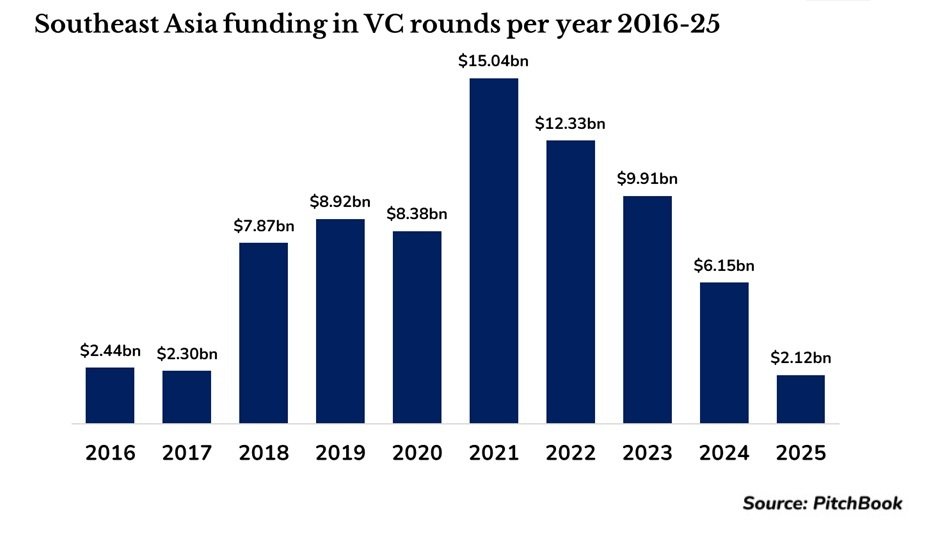
Startup ecosystems across Southeast Asia are contending with a tougher funding environment as investors become more selective, shift toward deep‑tech and AI themes and demand clearer paths to profitability. After a period of abundant capital, aggregate funding has moderated, with seed and early‑stage rounds particularly affected even as some larger deals continue to close.
Venture investors and corporate VCs are reorienting portfolios toward technologies with defensible IP and long‑term secular drivers, such as AI infrastructure, industrial automation, climate‑tech and advanced healthcare solutions. This has left some consumer‑internet and commoditized fintech models struggling to raise follow‑on capital unless they demonstrate strong unit economics and market leadership. Founders in crowded verticals like last‑mile delivery or generic e‑commerce are being pushed to consolidate, pivot or exit.
The capital‑raising headwinds are prompting many Southeast Asian startups to look beyond their home markets earlier in their growth journey. Companies are exploring expansion into the Middle East, Europe or North America, or tapping global accelerators and strategic partners to access new investors and customers. Some are also re‑domiciling holding structures to jurisdictions seen as more favourable for large‑scale capital‑markets access.
At the same time, local governments and development agencies are trying to backstop funding gaps through co‑investment schemes, grants and sovereign‑fund programs. However, these initiatives are generally not a full substitute for private venture capital, which remains critical for high‑growth scaling. Observers note that the current reset may ultimately strengthen the ecosystem by weeding out weaker models and encouraging more disciplined capital allocation and governance. Despite short‑term challenges, Southeast Asia’s structural attractions — young demographics, digital adoption and rising incomes — continue to support the long‑term case for startups. For founders, the new funding reality means sharpening business models, building cross‑border resilience and aligning with investor appetite for deep technology and AI‑enabled solutions.