
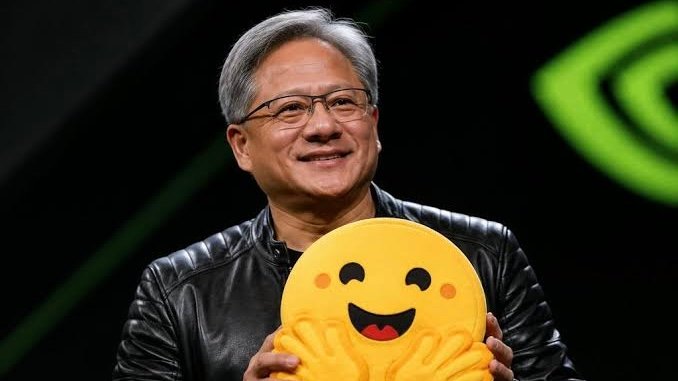
Nvidia’s agreement to buy Hugging Face for $12.9 billion marks one of the most consequential deals in the artificial intelligence industry this year. The acquisition pushes the chipmaker further up the AI stack and gives it direct control over the world’s best-known open-source AI model hub, a platform that has become central to how developers build, test and distribute machine-learning tools.
The logic behind the purchase is straightforward. Nvidia has long dominated the hardware layer of AI, supplying the chips that power training and inference across the industry. But the company is now trying to secure more of the software environment around those chips, especially as major customers explore their own custom silicon and seek ways to reduce dependence on Nvidia’s GPUs.
Hugging Face is not just another startup. It has become a key destination for open-source and open-weight AI models, a place where developers share, adapt and deploy systems used across the industry. By buying the company, Nvidia is moving closer to the community of builders that increasingly shapes how AI is adopted in practice.
That matters because the AI race is no longer only about who has the fastest chip. It is also about who controls the tools, models and distribution channels that developers use every day. If Nvidia can shape the platform layer as well as the compute layer, it gains a stronger strategic position even if rivals continue to challenge its hardware edge.
The transaction is also a response to competitive pressure. Large cloud providers and major technology customers have been investing in custom chips, which can reduce their reliance on Nvidia’s processors over time. The Hugging Face deal helps Nvidia defend against that threat by making the company more central to the broader AI ecosystem rather than just the hardware market.
Open-source AI is a particularly important part of that ecosystem. Developers increasingly want access to models they can inspect, modify and run on their own systems, rather than depend entirely on proprietary APIs. Hugging Face sits at the center of that trend, which is why ownership of the platform carries strategic weight well beyond the headline price.
The deal also reflects a larger industry pattern. As AI infrastructure becomes more expensive and more competitive, leading companies are trying to lock in long-term advantages across multiple layers of the stack. Nvidia’s move suggests it is willing to spend heavily to make sure the next wave of AI development remains connected to its ecosystem.
There is also a talent dimension. The structure of the acquisition includes a retention pool for employees who join Nvidia, underscoring that the company is not only buying technology and platform reach but also human capital. In a fast-moving sector where engineering teams can make or break product execution, that matters just as much as the assets themselves.
For developers, the key question is whether the acquisition changes the openness of the Hugging Face platform. Nvidia has said support for builders will continue, but any ownership change in a major open-source hub naturally raises questions about governance, access and neutrality. Those concerns will likely stay in focus as the deal moves through integration and implementation.
The broader market reaction will depend on how investors view Nvidia’s long-term growth profile. On one hand, the purchase strengthens Nvidia’s relevance at a moment when AI demand remains intense. On the other hand, it also brings the challenge of integrating a large software community into a company best known for selling high-performance chips.
That integration challenge should not be underestimated. Hugging Face’s value comes partly from trust: developers use it because it is seen as a neutral and accessible place to work with models. Nvidia will need to preserve that trust if it wants the platform to continue growing without alienating the very users that make it important.
Still, the strategic rationale is clear. AI is maturing from a hardware boom into a broader ecosystem battle, and Nvidia does not want to remain only a chip supplier. By buying Hugging Face, it is positioning itself as a more complete AI platform company with influence over infrastructure, software and community adoption.
The timing also fits a wider shift in the sector. As competition intensifies, technology companies are looking for ways to build defensible moats around AI. Ownership of a central developer platform gives Nvidia one such moat, especially if the company can combine cloud partnerships, model hosting and chip deployment more tightly over time. For the AI industry, the deal is a signal that the battle over control is moving upward. Chips still matter, but the platforms where developers gather may matter just as much. Nvidia has chosen to own both sides of that equation.
