
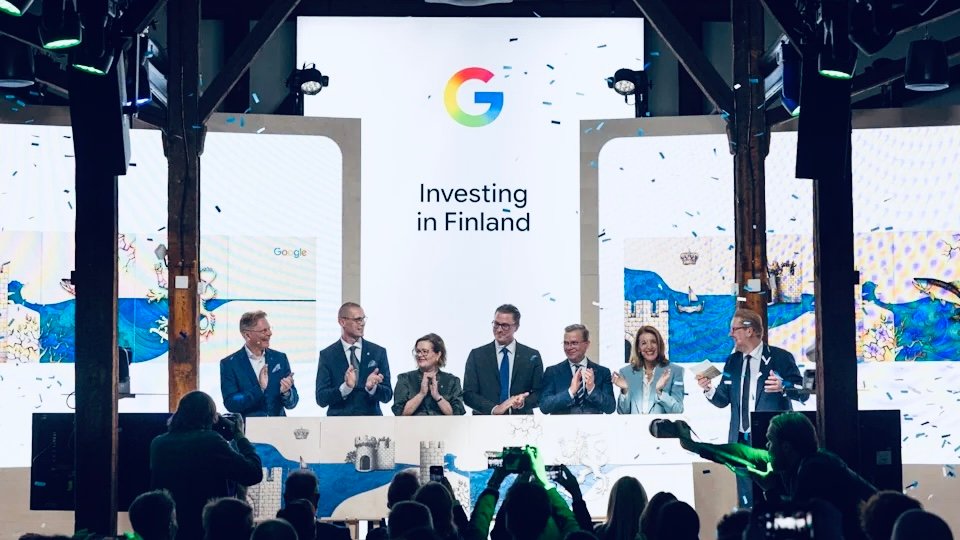
Google’s plan to invest at least €13 billion, or about $15.1 billion, in artificial intelligence infrastructure in Finland is its biggest investment in Europe and one of the clearest signs yet of how expensive the AI race has become. The project will fund data centres, grid upgrades and energy-related work over the next two years, with the build-out scheduled for 2027 and 2028.
The scale alone makes the announcement significant. Google said the Finland investment will include at least three new data centres, expansion of an existing site in Hamina and a major agreement related to nuclear power supply. The deal shows that AI infrastructure is no longer just about servers and chips; it is also about electricity, land, cooling and long-term energy security.
That broader requirement is one reason Europe has become a critical arena in the global AI build-out. Companies want stable power, favourable climate conditions and regulatory systems that can support very large facilities. Finland offers a colder climate and access to advanced energy infrastructure, making it an attractive location for power-intensive data-centre expansion.
For Google, the investment is about more than capacity. It supports products such as Gemini, Search, Maps and YouTube, all of which depend increasingly on AI infrastructure to improve performance and scale. The company is treating infrastructure spending as a direct input to product competitiveness rather than a back-end cost.
The numbers also show how committed the company is to AI expansion. Google said the investment could contribute about €3.6 billion to Finland’s GDP during construction and support around 7,000 jobs annually once operational. That makes the project significant not just for Google, but also for the local economy and its industrial ecosystem.
The Finland announcement also highlights a growing strategic issue for Europe: energy capacity. Opposition parties in Finland warned that the influx of data centres could strain power supply and push up prices, a reminder that AI growth can create new policy problems even as it brings investment and jobs.
That tension is becoming common across global technology markets. AI leaders are racing to build as much capacity as possible, but the physical footprint of that expansion is large and increasingly hard to ignore. Data centres require reliable electricity, backup systems and long-term planning, which means technology strategy is now inseparable from industrial policy.
Google’s investment also reflects competition with other cloud and AI giants. The company is under pressure to prove that it can keep pace with rivals in model development, cloud services and enterprise AI adoption. Large infrastructure bets are one way to reassure investors that it intends to compete at scale.
The involvement of energy supply in the Finland deal is particularly telling. Google said the package includes a 22-year purchase agreement for up to half the output of one of Finland’s nuclear plants, showing how long-term and capital-intensive AI infrastructure has become. That kind of arrangement would have looked unusual in a previous era of software investment, but it now appears central to AI growth planning.
For Finland, the opportunity is substantial. The country could gain new jobs, stronger digital infrastructure and a higher profile in the European tech map. At the same time, it will need to manage trade-offs around grid stability, permitting and energy prices if the investment wave continues.
The wider significance lies in the message the deal sends about AI economics. Companies are no longer just buying model talent and cloud capacity; they are buying energy certainty, geographic resilience and data-centre scale. Google’s Finland project captures all three.
It also suggests that Europe may become more important in the global AI supply chain, not only as a user market but as an infrastructure base. If enough power and policy support are available, countries like Finland could attract a growing share of strategic digital investment.
The project may therefore become a reference point for the next phase of AI expansion. It shows that the race is no longer abstract or entirely software-driven. It is physical, expensive and tied to national infrastructure decisions. In that sense, Google’s Finland commitment is bigger than a single corporate announcement. It is a reminder that the companies leading the AI boom are now building the equivalent of industrial empires, and they are doing it one data centre, one grid upgrade and one energy contract at a time.
