
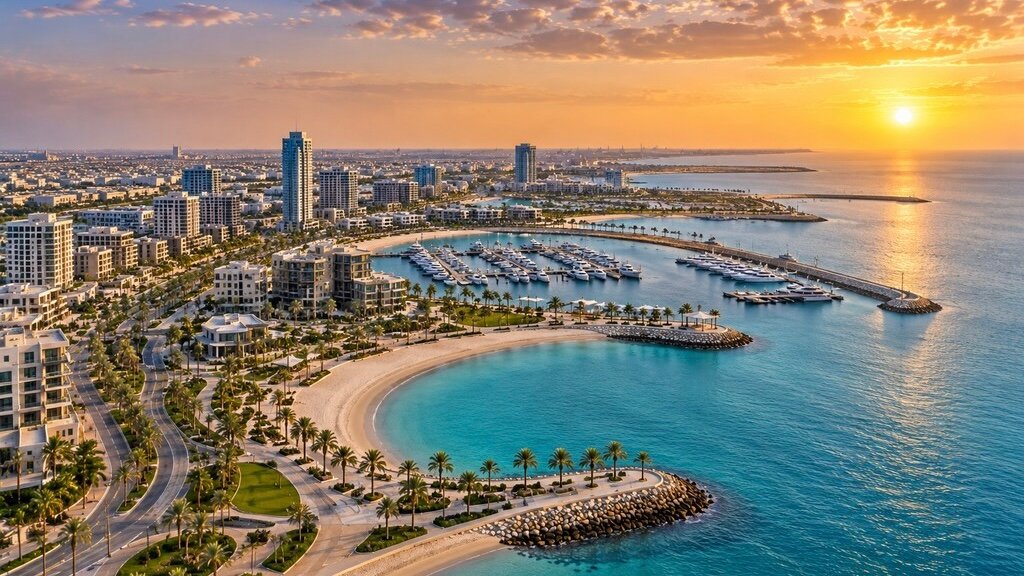
Saudi Arabia’s Public Investment Fund has launched the Gulf Coast Development Company to create a large tourism and residential destination along the Al-Khafji coastline. The project will cover around 20 square kilometres and extend across 10 kilometres of Arabian Gulf waterfront near the Kuwaiti border.
The development will combine housing, hotels, commercial facilities, tourism attractions, educational services and marinas. Once completed, it is expected to include eight residential neighbourhoods with more than 16,000 housing units and approximately 1,400 hotel rooms.
The announcement expands Saudi Arabia’s growing portfolio of destination-led real-estate projects. Rather than developing only isolated housing or hotel schemes, the new company will work toward an integrated community designed to attract residents, visitors and private-sector investors. The model reflects the kingdom’s wider effort to connect real estate with tourism, infrastructure and economic diversification.
PIF said the company would develop the project in partnership with the private sector, alongside local and regional investors. That approach is significant because it gives private companies a role in financing, constructing and operating parts of the destination, while the sovereign fund provides strategic direction and investment support.
The location is central to the project’s appeal. Al-Khafji sits in Saudi Arabia’s northern Eastern Province, close to Kuwait and the wider Gulf market. Its position could help the destination attract visitors from neighbouring states, as well as domestic travellers from Saudi Arabia and residents seeking new coastal housing options.
The first phase is scheduled for completion in 2030. It will deliver three residential neighborhood’s and establish the foundations of the wider tourism and residential community. Development will continue in three phases, allowing infrastructure, housing and commercial facilities to be delivered progressively rather than all at once.
The scale of the project gives it importance beyond the property market. More than 16,000 homes could create a sizeable new residential base, while 1,400 hotel rooms would add accommodation capacity in a part of the country that has not traditionally received the same international attention as Riyadh, Jeddah or the Red Sea destinations.
The inclusion of educational facilities is also notable. It indicates that the project is intended to function as a permanent community rather than a seasonal resort. Schools, public spaces, commercial centres and marinas can help create a more complete urban environment, supporting residents throughout the year.
For Saudi Arabia, this type of development supports several policy goals at once. It can expand tourism capacity, encourage domestic travel, create jobs, stimulate construction activity and attract private capital. It also helps spread major development activity beyond the country’s largest established cities.
The project comes as PIF continues to support large-scale infrastructure and destination developments across the kingdom. Its investments are designed to strengthen new sectors and create assets that can generate economic activity over decades. The Gulf Coast Development Company fits that long-term approach by focusing on a complete destination rather than a single building or short-term real-estate scheme.
For developers and contractors, the project could create opportunities across construction, engineering, hospitality, retail, education and marine infrastructure. Private-sector participation will likely be important because the site will require a wide range of expertise, from large-scale civil works to hotel operations and community management.
The development may also influence the northern Eastern Province’s real-estate market. New roads, utilities, public amenities and commercial activity could raise demand for nearby land and services. However, the scale of that impact will depend on how quickly infrastructure is delivered and how effectively the area is connected to surrounding population centres.
The project’s proximity to Kuwait gives it a potential cross-border dimension. Gulf visitors are already familiar with short regional trips, and a coastal destination near the border could appeal to families, tourists and second-home buyers. That opportunity will depend on the quality of attractions, ease of access and the strength of the final hospitality offering.
There are also execution challenges. Large coastal developments require careful planning around utilities, transport, environmental protection and construction sequencing. The project will need to balance tourism growth with the protection of the waterfront and the creation of practical services for permanent residents.
The three-phase structure suggests that PIF is taking a measured approach. Delivering the first three neighborhood’s by 2030 will allow the company and its partners to test demand, refine the development model and build confidence before later phases are completed. It also provides time to coordinate hotels, commercial facilities, schools and marina infrastructure.
The project shows how Saudi real estate is becoming more closely linked to national economic strategy. Housing is only one part of the plan. The broader objective is to create places that can attract visitors, support businesses and improve quality of life while contributing to the kingdom’s transformation agenda.
For the private sector, the launch creates a new investment platform with a clear geographic identity and a long delivery horizon. For PIF, it adds another destination to a growing national development map. For Al-Khafji, it could represent the most significant transformation of the coastline in decades. The Gulf Coast Development Company therefore marks more than the creation of another Saudi developer. It signals an effort to turn a strategically located coastline into a permanent economic and tourism hub, combining homes, hotels, public facilities and waterfront attractions in one integrated project.
